I am now back from internet holiday (hooray!) and spent my first day back in the all hands meeting for my organization, The Permanente Federation, where we concluded with an interesting exercise. We were asked to draw an image of ourselves and explain it to colleagues.
I drew a stick figure with a megaphone and described myself as working always to give those without a voice, a voice. It’s a theme that runs through all my social media content, and I think it’s the most amazing/important thing physicians can do in society (It’s the main thesis of my presentation at the 2011 ONC Meeting, in fact). Whenever I have observed a health care interaction where the patient voice was taken away, I left disappointed. Conversely, I am drawn to physicians and people I know who use their skills and tools available to give people a voice where there was none previously.
Today reminded me of my walk with Brigid McCaw, MD, MS, MPH, FACP, who is Kaiser Permanente’s clinical lead on family violence prevention and has earned local and national awards for her work. Here’s the photo I took of her right after our walk together:
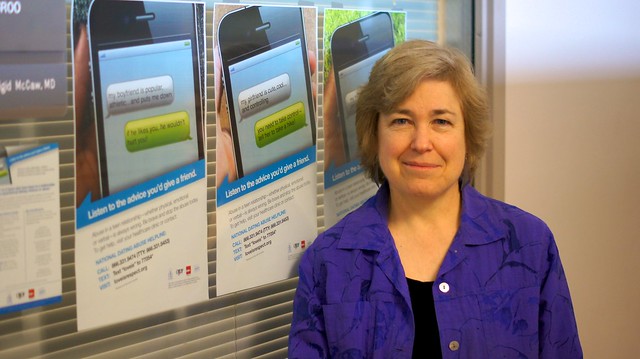
View Brigid McCaw, MD on Flickr.com
She’s standing in front of posters for a campaign that she’s supported, part of the National Dating Abuse Helpline.
On our walk, we talked about Brigid’s own journey to prevent family violence, which began when she was a medical student who learned that her sister was secretly fighting for her own life, with virtually no resources available to assist her (you can read the story written about Brigid here). She told me about innovative work studying adverse childhood experiences (ACEs as they are called, with the original cohort from Kaiser Permanente patients), and about listening to patients and going deeper than clinical symptoms to understand the causes of unwellness.
We (of course) talked about social media and I think we had a mutual epiphany. We know social media can be a very powerful tool for the engaged, but what about the disengaged? How could we learn about the things patients don’t tell us in the exam room, or don’t e-mail to us in our secure patient portals? Brigid’s work has shown that asking more and then doing more is effective, and these approaches can be systematized to help a lot of people (meaning, saving lives). We both share the interest in using social media to listen more, and listen more to people who are not listened to normally.
Brigid’s work is accessible through the Kaiser Permanente Family Violence Prevention Program. Within this site is the silentWitness display and stories. The site is dedicated to three Kaiser Permanente staff members who were killed as a result of family violence. It includes 12 moving stories of Kaiser Permanente physicians, nurses, staff, male and female, who were the victims of family violence; it shows their courage, survival, and hope.
I asked Brigid what she would wish for if she had the superpowers of her choice, and she told me:
Using my US hat, I think healthy parenting and models of healthy intimate relationships are an essential key to preventing future domestic violence. So I would wish for each child a home with adults who love them and are caring and respectful to each other (and to their parents- this is a trans-generational thing).
Wearing my hat as a global citizen, I think that we may need to start at a more basic level- assuring women’s rights. Unless basic human rights are assured, the other things sound nice, but probably don’t mean much in real and practical terms.
Her colleague and my mentor of many years, David Sobel, MD, offered this unsolicited endorsement of the understanding that this work has brought to our profession:
Brigid is a gem. She has championed the work to help identify and support patients who are threatened by family violence… and develop specific resources and protocols to support clinicians and patients to take effective action. If a patient is facing threats at home, how likely is it that their number one priority will be managing their diabetes, exercising, taking their medications, etc.. We must help patients address what is most salient and important in their lives, and unfortunately, too often it involves family violence. Thanks to Brigid and others for bringing this issue front and center – for the benefit of patients as well as their caregivers.
It is interesting that these physicians, who train in and work in the most technologically advanced health systems in the world, conclude that the basic needs and environments of their patients and communities are key to supporting overall well being. One of the most important abilities physicians have to help our patients get there is listening and providing them a voice. It really is a beautiful thing.
17 Comments
RT @tedeytan: Giving the voiceless a voice using social media, family violence prevention via KP Dr. Brigid McCaw http://t.co/g1cYaqHV #hcsm
I wrote a blog last year about my own personal experience with domestic violence. That blog was by far the hardest one I’ve ever written. I was surprised to see how many people sent me private emails to thank me for being brave enough to share my story. I want to thank you Ted for recognizing Brigid and her amazing work. Brigid on behalf of those searching for their voice, thank you. http://proactivecare.blogspot.com/2011/10/her-silent-plea.html
@ldsklandrews Kristen,
Thank you both, and thank you for using this medium personally to improve understanding of this problem. Now that you are venturing from amateur to semi-pro in social media, do you have any insights about how this two-way communication medium might be used to help men and women in the future? You mentioned the fold-out cards in bathrooms. What would be the 21st Century version of those online? Do you think men and women who are suffering tend to send signals in their social media use? Recently I was reviewing a feed of people who made public comments about Kaiser Permanente on Twitter. In one, a twitter friend @ replied the comment with a tweet that said, “Is everything all right, boo?”
This post and one other (okay maybe a few others) also reminded me that i tend to have people around me who have a sense of a “duty to rescue.” This may end up being the inspiration for #TedsWalkingJacketNumber2 at this year’s The Walking Gallery (are you coming?),
Ted
@tedeytan In my mind, the 21st century version would have one of those scan bar codes on the flier in the bathroom to accompany the fold-out cards. Patient’s could scan it and get immediate access to online support systems and resources. The world is a very different place from when I experienced this issue. Now with technology right at our fingertips, we need to find a way to use social media to get the message out that people in this situation are not alone. Help is out there. We are listening and we care. I have seen plenty of examples of people attempting to reach out through tweets, facebook, etc. Though admittedly, it’s hard to tell if it’s just song lyrics being posted by the younger generation or legit concerns. I, like you, feel the need to rescue. Where do we begin? How DO we get involved more?
p.s. I would love to go to DC for the Walking Gallery – just need a good reason to get KP to pay for it 🙂
@ldsklandrews Kristen,
I love the quote about being able to tell between song lyrics and legitimate concerns, that illustrates the challenge and work we can do to figure this out.
I thought about this and then I realized it’s easy to tell the difference….if you know the person. So if we are good at gaining people’s trust and building strong relationships with them, we’ll be able to tell the difference as human beings. If we / the industry tries to over algorithmatize this, they may find themselves lost – which brings us right back to the choices we’ve made in terms of health care delivery.
I write this response after I just listened to my interview with Regina Holiday that I posted here: https://www.tedeytan.com/2012/04/15/10509 – I asked her at the end about Complete Care and social media’s potential role in it. Her answers are very interesting and helpful. Take a listen, and pass around! I’ll also post on Ideabook (our internal social network).
Let’s chat more about The Walking Gallery if you are up for it,
Ted
@tedeytan @reginaholliday I just finished listening to the beautiful, engaging, and powerful interview. I feel like one of my roles being in the role I am in is to help provide the voice of the patient. I think people may get tired of hearing me say “when my daughter was sick and in and out of the hospital for six months, here’s what I learned…”, but I keep saying it because I know it’s the right thing to do. When we introduce new initiatives, like exercise vitals or alcohol screening, I bare my soul to let others know why it is important to ME and why it is the right thing to do for our members. “I love Regina’s comment about having been through hell and back – why hold back”.
About Regina’s comments about how we can continue to improve, I feel like that is just a small glimpse into the wheels that are turning in her mind and I would love to hear more. In SCAL, we DO send reminder emails for some of our outreach, as well as text messages. Still there are so many opportunities to improve – which is the beautiful thing about what you and I get to do everyday!
I’m will gladly pay my own way to the Walking Gallery event if I can get Regina to paint me a jacket 🙂
@ldsklandrews @tedeytan @reginaholliday Kristen,
Well, you now have the tools to contact her: @ReginaHolliday – tell her you have a great relationship with the person who designed the beautiful pin she’s wearing in the photograph that I took before we started the interview. 🙂
Ted
I always wonder if my blogs make a difference and yesterday, I found out, they do.
Yesterday, as. Got off the elevator for work, I was greeted by a co-worker who was accompanied by another friend and kp employee. My co-worker, who also happens to be my go to person for difficult ad-hoc reports, asked if they could speak with me privately in my office about something that wasn’t work related. Intrigued, I said of course and led them in.
After a brief introduction, my co-worker “Monica” said “I was hoping that you could share the story from your blog on domestic violence with “Karen”. I also thought that because of your role and experience you might now what to do next.” My heart pounding I my chest, I shared my story of abuse, survival, and regrowth. Karen who first entered my office with eyes diverted and shoulders hunched,now sat forward, tears I her eyes, but with a look that appeared to me to be hope.
I asked if she woukd feel comfortable opening up to me and slowly, quietly, she did. Then I asked her if she was ready to make a change. I explained the path I took (restraining order, emergency shelter if needed, walking away from everything if that’s what it took, counseling, etc ). I called the EAP coordinator to help her get the ball rolling. An hour and a hug later, she was on her was on her way to meet with EAP.
I closed my door after they left and had a good cry. I cried because opening up and sharing meant I had to relive my past for a brief moment. I cried because I hurt for this person who is now walking down a terrifying road. I cried because I realized that what Ido and who I am really does make a difference. Going home, I couldn’t help but smile to myself as I thought “today was MY day to live the motto I preach everyday… “saving lives… One person at a time”. It was my day to save a life and it felt really damn good.
Just had to share with you Ted. Thanks for encouraging me to start up a blog, tweet, and tell our(my) story.
@ldsklandrews Dear Kristen,
You know, more than a few doctors tell me, “I don’t see the role of social media in health care.” And I agree with them, if we are talking about the way social media is being used by most health care organizations today.
However, if we talk about the way you are using it, to share authentic stories related to care delivery that is person-centered, by leaders who bring themselves to the conversation, that’s a different story.
I now have a story to tell, thanks to you!
Ted
@ldsklandrews www.SchoolandUniversity.com help me find a college, Online University, Online College, Online Schools.http://www.trafficgeyser.net/lead/help-me-find-a-college
RT @tedeytan dedicated physician who I want everyone to meet and vice versa. Learn abt her http://t.co/m4U7SNJ9 <- will look fwd to meeting
@tedeytan @TrishaTorrey @ReginaHolliday SO COOL! Thanks for bringing her along!
RT @tedeytan dedicated physician who I want everyone to meet and vice versa. Learn abt her http://t.co/m4U7SNJ9 <- will look fwd to meeting
RT @tedeytan dedicated physician who I want everyone to meet and vice versa. Learn abt her http://t.co/m4U7SNJ9 <- will look fwd to meeting
[…] passionate and prolific advocates of digital communications in medicine. In his piece, “Giving the voiceless a voice using social media, family violence prevention, and a walk with Brigid …” he touches an important subject: The fact that social media is enabling new voices to emerge […]
[…] of the work of one of my other favorite physician innovators, Brigid McCaw, MD (@BrigidMcCaw) (See: Giving the voiceless a voice using social media, family violence prevention, and a walk with Brigid …). Isn’t it interesting that some of the greatest innovation I see in medicine involves better […]
[…] I walked with passionate advocate for family/intimate partner violence prevention Brigid McCaw, MD (Giving the voiceless a voice using social media, family violence prevention, and a walk with Brigid …), we talked about social media’s role in giving the voiceless a voice. If you look at […]